Real solve · panel method
Guess first.
Then compute it.
Three physics challenges, solved on a real finite-element server while you watch.
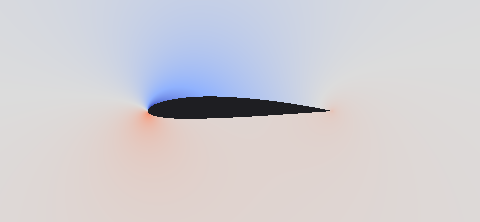
C_p α 4.6° V∞ 40 m/s Target 800 N/m
Challenges
-
How much tilt does a wing need?
Hold up about 80 kg for every metre of wing.
-
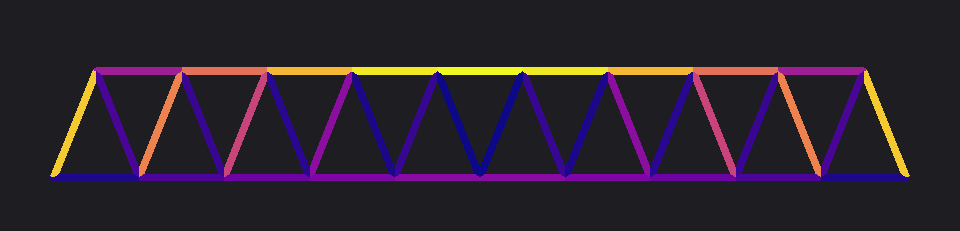
Which bar gives way first?
10 tonnes on the deck, 2.4 tonnes of steel at most.
-
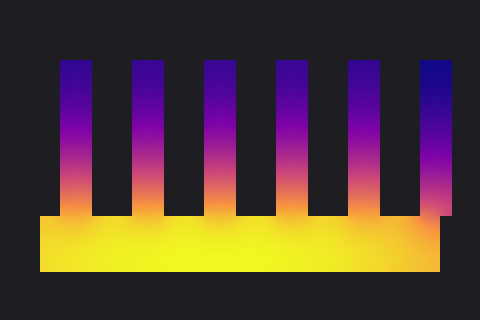
Do more fins always cool better?
30 W under 95 °C, on 170 g of aluminium.
-
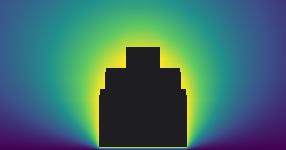
Can a capacitor tell you where a mirror is?
A third of a nanofarad per millimetre, straight over twenty microns.
How it works
Method, code and data
The answers are not canned animations: they are computed from the configuration in front of you. Each challenge uses the model that suits it, and offers numerical controls, the full set of quantities and a data export. The lab's code is open source.
- Wing — a panel method on the surface of the section itself.
- Bridge — one bar element per bar, solved once.
- Heat sink — conduction through the metal, with convection and radiation at the surfaces.
- Gap sensor — electrostatics on a section through a body of revolution, solved at a series of gaps.
- Magnetostatics — the field in a two-dimensional section.
Checking what is installed on this server…
How it is made
The lab is an application built on Fenix Spoon, an open-source toolkit that puts a finite-element solver behind a web page. What you find here is the teaching experience built on top — the problems, the explanations, the design and the public deployment.
The code for this lab is on GitHub under the MIT licence. The finite-element computations are carried out by FEniCSx, and the rest by NumPy.